
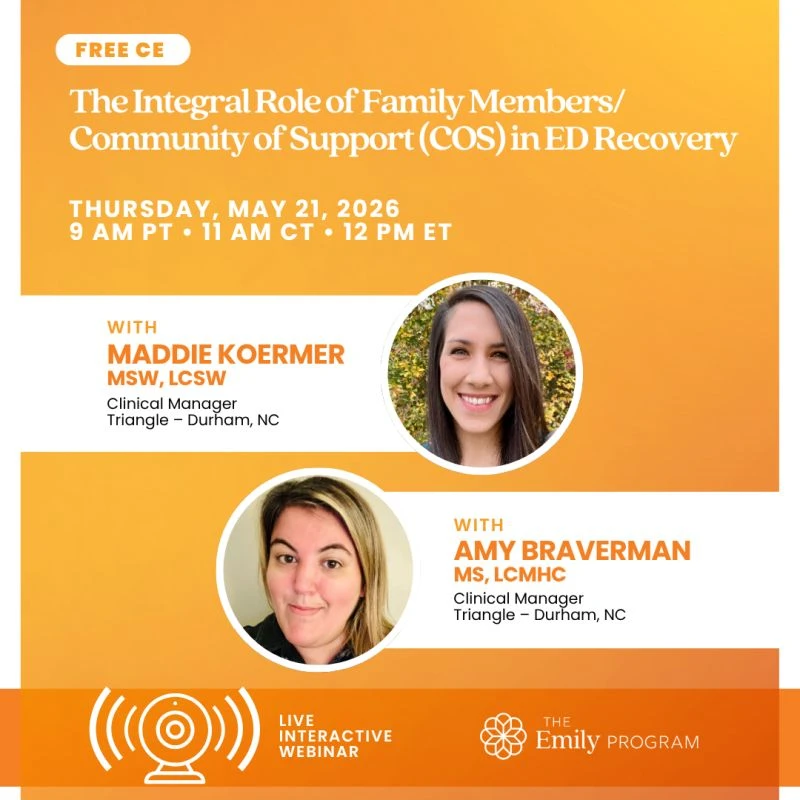
Supports play such an integral role in the treatment of eating disorders. In this presentation, we will discuss benefits of engaging an individual's supports, impact of not involving supports, ways to engage supports, topics that are helpful to cover in treatment, common questions during treatment, and ways to navigate difficult treatment conversations. We will include some vignette- based scenarios for discussion including both the patient and support persons experience.
Learning Objectives
- Identify at least 3 benefits of engaging supports in eating disorder treatment.
- Name 3 ways that families/COS can support a loved one in eating disorder treatment
- Explain at least 3 strategies to navigate difficult conversations within eating disorder treatment
Target Audience
Professional counselors, mental health professionals, dietitians, social workers, healthcare providers, and individuals seeking to expand their knowledge in these areas.
Learning Levels
- All Levels
Agenda
1. Agenda setting (2 min)
2. Define "supports" (3 min)
3. Discuss benefits of family/ COS involvement in ED treatment
(5 mins)
4. Highlight many ways to engage family/COS in treatment (5 mins)
5. Address the impact of not involving families/COS in ED
treatment (5 mins)
6. Explore helpful topics to weave into treatment (5 mins)
7. Review common questions/concerns that arise in treatment
(5 mins)
8. Discuss ways that families/COS can support loved ones in
treatment (5 mins)
9. Navigating difficult conversations (5 min)
10. Case Vignettes (10 min)
11. Q & A (10 min)
Maddie Koermer (she/her) is a Clinical Manager of Outpatient Services at The Emily Program’s Triangle Child, Adolescent & Adult Eating Disorder Treatment Center in Durham, North Carolina. Maddie greatly appreciates being part of a client’s care team and enjoys walking alongside clients and families as they navigate the recovery journey.
Maddie obtained her Master of Social Work (MSW) from Loyola University of Chicago and is a Licensed Clinical Social Worker (LCSW) in North Carolina. She began her career at The Emily Program (formerly Veritas Collaborative) in 2016 and has experience working with clients and their families across multiple levels of care, including inpatient, residential, partial hospitalization (PHP), and intensive outpatient (IOP). She is particularly passionate about the PHP and IOP levels of care and multi-family programming.
As a clinical manager, Maddie is always pleased to help connect families to psychoeducational and supportive resources in their local area. She also thoroughly enjoys supervising student interns and clinicians in eating disorder treatment. Maddie pulls from various treatment modalities, including dialectical behavior therapy (DBT), family based therapy (FBT), and motivational interviewing. She strongly believes that every eating disorder is significant enough to receive help.
Maddie embraces diversity and believes in the importance of a non-judgmental, inclusive recovery environment. Maddie is an active Equity, Diversity, and Inclusion (EDI) Council member at Accanto Health.
Amy Braverman (she/her) is the Clinical Manager of The Emily Program’s Triangle Child, Adolescent & Adult Eating Disorder Treatment Center in Durham, North Carolina. In this role, Amy serves as clinical and staff support for adult partial hospitalization (PHP) and intensive outpatient (IOP), and adolescent PHP/IOP. Amy is an experienced resource for our clients, able to provide individual therapy, family therapy, couples therapy, group therapy, clinical supervision, and therapeutic meal support.
Amy is a Licensed Professional Counselor (LCMHC) in North Carolina, earning her Master of Science in mental health counseling from Nova Southeastern University. Since 2019, Amy has worked with clients across numerous levels of care, including inpatient, residential, and PHP/IOP. She utilizes an integrated approach to therapy, which incorporates features of dialectical behavior therapy (DBT), acceptance and commitment therapy (ACT), cognitive behavioral therapy (CBT), and exposure and response prevention (ERP). Her interest in lower levels of care led her to her current role as a clinical manager.
Amy loves to learn and even helped develop the curriculum utilized across Accanto Health. She strongly believes that thorough assessment and development of an evidence-based treatment plan underpin the success of treating eating disorders. Amy is also passionate about increasing access to care for all individuals who are struggling. She enjoys partnering with external community providers to provide education on the detection and treatment of eating disorders. One of Amy’s goals is to grow awareness of inherent biases surrounding body size and nutrition, as well as to break down harmful eating disorder-related stigma.