
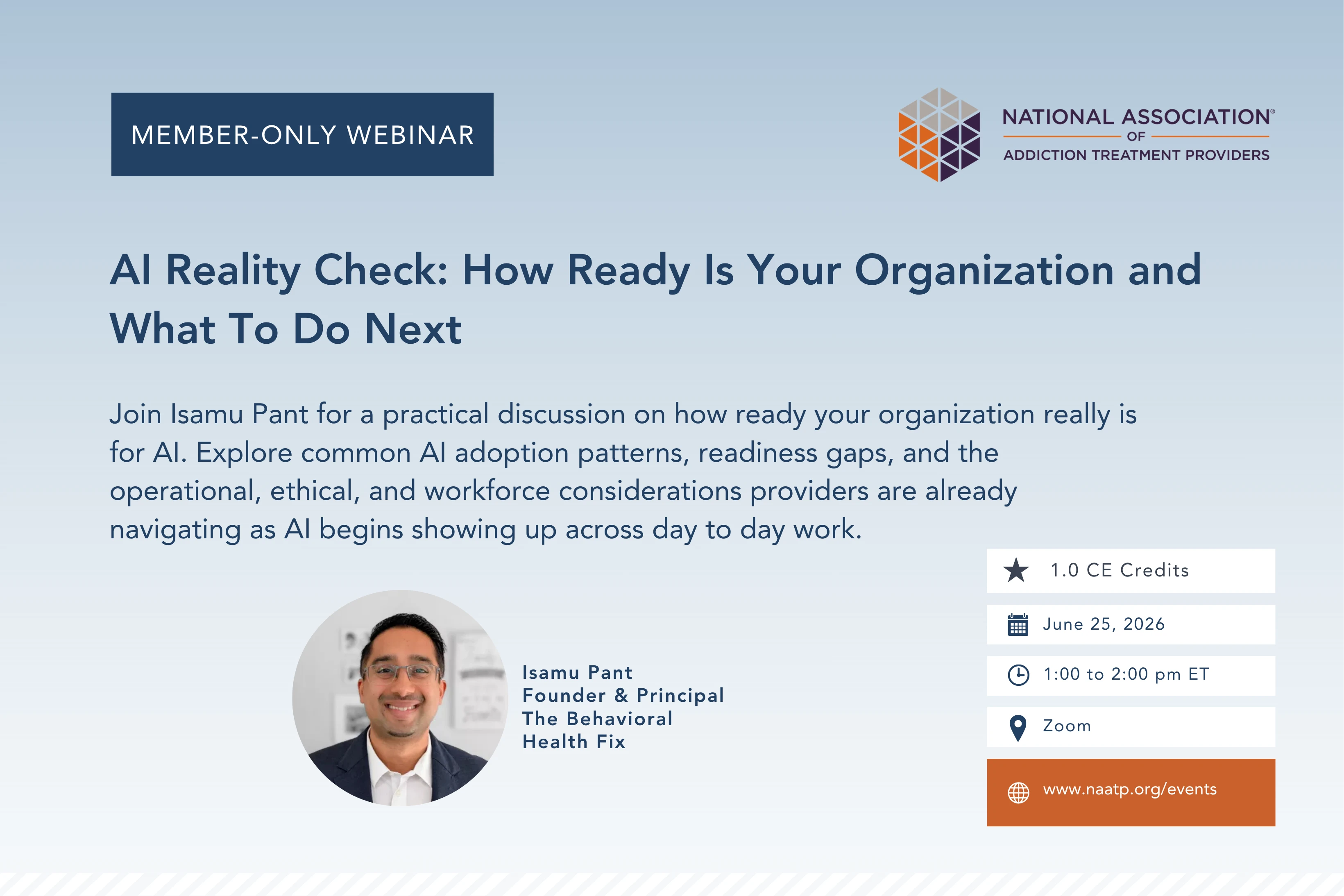
This session gives members a clear way to understand where their organizations actually are with AI today. We’ll use four common AI “archetypes” and three readiness pillars (governance & guardrails, operational groundwork, workforce & clinical trust) so attendees can see themselves and the risks/opportunities that come with each pattern. We’ll also talk directly about what many providers are already experiencing: AI showing up informally in day to day work (often driven by individual staff rather than leadership), with little policy or structure around it, and what that means for ethics, compliance, and safety. Participants will receive a simple planning tool and a team agenda they can use with their leadership teams to map current AI use and guide a focused internal discussion. The focus is not on turning AI off, but on recognizing the early, fragmented use that already exists and beginning to put simple, workable guardrails around it.
Learning Objectives
By the end of this webinar, participants will be able to:
- Identify which of the four AI archetypes best describes their organization today and what that implies for risk and opportunity.
- Assess AI readiness across three pillars: governance & guardrails, operational groundwork, and workforce & clinical trust.
- Use a provided planning tool and agenda to (a) inventory where AI is already showing up in their organization, and (b) run a 60 minute leadership meeting on “where we are now and what we’re comfortable with.”
Isamu Pant is the founder of Behavioral Health Fix and author of The Behavioral Health Fix: A Leader’s Guide to Better Care, Happier Staff, and Smoother Operations. He works directly with behavioral health and IDD executives to fix long standing operational problems and grow without burning out staff or putting care at risk, often in focused 30 day sprints.
Before launching Behavioral Health Fix, Isamu built analytics and operating systems inside a 500 person community behavioral health center and later helped Amazon Web Services stand up and scale a new cybersecurity and early AI services organization. He now brings that combination back to the field to help leaders use AI in ways that support care, workforce sustainability, and ethics, rather than chasing tools.
Recent appearances include the opening keynote at the Behavioral Health AI Summit and the Behavioral Health Business Perspectives podcast on the field’s first AI related labor action.